What I Learned From Ratilal Chandaria

“You must remember that for a man like you to live in itself is a service to your country, for your life is not merely useful, but it is a light to others”
Rabindranath Tagore to G K Gokhale
Dec 1913.

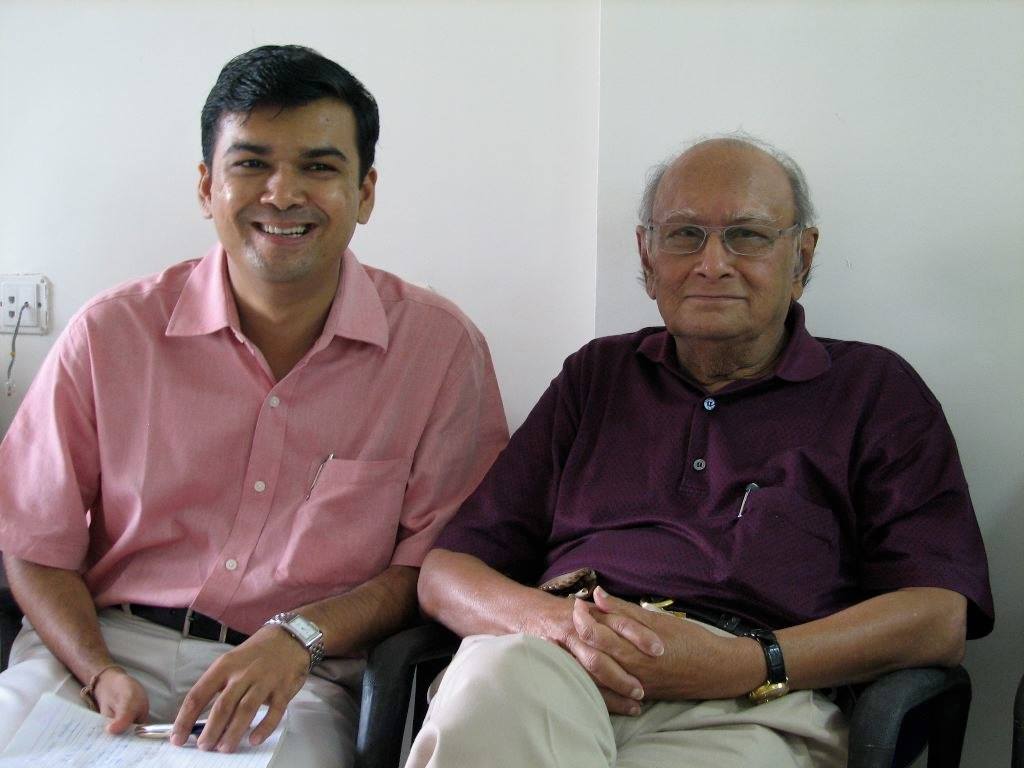
Shri Ratilal Premchand Chandaria holds a special place in the hearts of innumerable people. For me, he is a father figure. Over the multiple projects and years, I came across the extraordinary individual that Ratibhai was. He was a person who was razor sharp in his thinking, intellect and memory. He was a person with tremendous zeal and energy. At the same time, he was a very kind and caring individual. He worked his entire life with the agility of a roaring tiger and lived his life with his principles – Ratibhaism.

The following are the important lessons that I learned from him:

1. Never Accept No For An Answer:

Ratibhai (Kaka) never accepted NO for an answer. His persistence is legendary. He would never leave any work incomplete. Whatever things he set his sight on, he would achieve. He would find ways to overcome hurdles. And he did not mind seeking help for achieving the goal.

He had given 20 years of devotion and dedicated service to GL project. 20 years is a long time – our experience of a little more than 20 months on Gujarati language had been very frustrating and thankless. He chased people in USA, UK, Canada, Germany, France, and India etc. He approached companies like Microsoft, Apple, Tata, CMC, etc. He achieved the GL mission and launched the GL project on Jan 13, 2006.

He went to Paris for developing a font. He went to Apple and sought help from them. On not getting the desired response, he found a few Indians in the Apple in an ingenious way. He persisted with these Indians in Apple to help him. He got contacts of a person in Paris working on Arabic Spellchecker. He went to Toronto to seek help.

2. Lead By Example:

Kaka could not accept No for an answer. At the same time, he was very hands-on. If things would not move, he would himself start working on it. He would often say to me – Aap Marya Vagar Swarge Javatu Nathi.

When he did not find enough experts, his assistant, his driver and he himself started typing the words. Kaka drove to Gondal to speak to the local team and seek help for digital rights of Bhagwadgomandal. If there were bottlenecks, he would visit people and start working on find ways. He would not wait for people to come to him. Beyond being Hands-On, he always believed in leading by example. His entire life he practiced what he preached.

3. Work For A Higher Purpose

Kaka and his family built a successful and sustainable business across countries. During the business time and after retirement, he contributed to the larger goals.

He worked on GujaratiLexicon with a simple mission – to do something for the mother tongue Gujarati. Gujarati is my mother – that was his common statement. He worked to ensure that every Gujarati person could access Gujarati on his computer. All tools are accessible in Gujarati. He worked with Madhu Rye for the first font in Gujarati. He worked with people across the world to make this happen.

He has achieved something impossible – something which Universities or large companies or Government should be doing. Also, he was spending time on a collective good, rather than pursuing his business. Had he spent the same time and effort and passion on his business, he would have added more jewels to his business treasure. But he chose to work for his mother tongue. Everyday morning, he would wake up and check the latest statistics of the GL project.

4. Attitude For Gratitude:

In this world, many seek help. But few remember to thank people for the help they get. People are transaction-oriented these days. But Kaka remembered and thanked everyone who would help him. He would never forget anybody who stood by his side and helped.

5. Share Credit:

Kaka always shared credit freely. Kaka met Dhirubahen Patel through some common contacts. He told Dhirubahen about the difficulty he faced. He told her that I fear I might die without seeing this project go live. Dhirubahen said that she would help. She got him help from many people to get the work checked. Kaka was very happy. When after some years, the project was complete and ready to be launched, Kaka expressed his desire to launch the project at the hands of Dhirubahen only. Friends and family had got many people invited at the event. Mr. Deepak Parekh of HDFC Bank and Dr. Viren Shah, Governor of Bengal were at the event. But he said that the project would be launched by only Dhirubahen and nobody else. Even the invite from CM Narendra Modi to meet him was converted into a courtesy visit and prelude to actual launch. And at the launch and even after that he expressed his gratitude for Dhirubahen.

6. Respect Women. Encourage Women.

Kaka encouraged women in all spheres of life. He was very happy that Arnion was formed with the entire Women Team. He was proud of the work done by the team. Kaka had a special respect for all women. It included Dhirubahen, friends and family members as well.

He even respected the contribution of Vijaya Kaki to his life. The surest way and the fastest way to make Kaka cry were to remind him about Vijaya Kaki. As Jan 26 approached, he would get emotional.

7. Nurture Relationships

Kaka sowed, nurtured and grew relationships. He would make special efforts to maintain the relationship. He would take personal interest in people and their lives.

Even his late eighties, Kaka drove to Surat to meet his friend Uttambhai and spend an entire day there. He would be personally interested to know how did the knee surgery of Uttam bhai went. Every year Uttambhai and Madhu Aunty would go for a nature-therapy break and Kaka would ensure that he exchanged enough emails before those visits – so that he would not miss them. And he would wait eagerly for them to return and see emails of Uttambhai.

Whenever we would be in Ahmedabad, he would visit Kumarpalbhai, Prabhahben, and Kasturbhai. Tushar Bhatt and he exchanged some notes via email. Next time he was in Ahmedabad – he met him. He would talk to me on Skype and every few days he would ask me about Dhirubahen, Vipoolbhai etc.

Whenever he would return to India, I would get a call from his team asking me to meet him immediately. Whenever I would go to his Mumbai home, he would ensure that I had my favorite vegetables (I am a fussy eater) and there was a Paan for me to eat. We shared our love for Paan and Pani Puri. When he was outside of India, Skype would ensure that we remained in touch. When I went to London, he would prepare tea for both of us in the morning. When I went out of his home in London, he taught me to navigate London’s metro. He would wait for me to return home. He would sit late till night and talk. And his talks would be about Gujarati language, technology and helping people. He never talked about himself !

Kaka had a problem in hearing but he always listened to my heart. He would know of things that I never spoke. He would know my feelings and thoughts. He was always there for me – my marriage, birth of Aditya and other milestones of life. When my wife was pregnant, he wrote emails to her and after her pregnancy, he was the first one to visit her – even ahead of my other family members. Whenever I had to make any decision or whenever I was low – one Skype call to him and I would be clearer. He was my life mentor. He stayed at my house in Ahmedabad and time would fly. And so would Kulfis and Pans. He was a foodie and would love exploring good food.

Kaka was very simple. After my first year of marriage, I decided to go to Mahabaleshwar. Kaka was in India and asked whether he would like to join. He was hesitant as he did not want to intrude into my privacy. I assured him that we were 100% comfortable and hence inviting him. In fact, we would not get such a vacation with Kaka. However there was a problem. I told Kaka that I stay at a small mini-resort cum hotel at Hotel Uday in Mahabaleshwar. There is no 5-Star accommodation there. He said that he was more than happy to accompany us. However during the journey to Mahabaleshwar, he stopped at Pune and decided to visit CDAC. He went to CDAC and told them to help with OCR.

8. Zest For Life

Kaka had tremendous zest for life. He believed in living life with full passion. He would enjoy his food. He would like to wear best clothes – he was always impeccably dressed. He would enjoy a great wine. He scolded me for not getting him a wine from my Europe tour. He would like to go out and spend a good time with his friend Dhirubhai. He would watch a movie with him at frequent intervals.

9. Family First

Kaka spoke only about two things – Gujarati Language and Family. He said that the entire achievements of his are achievements of family.

I have never heard any grudge or any ill-will Kaka had towards any family members. He would keep me posted about the activities in the family and it was his way of sharing joy. Whether it is the daughters of Kunteshbhai, or Sachin’s ventures or Jet-Ski accident of Vimalbhai, he would share it all. He loved talking about the family.

I can recount anecdotes and anecdotes on Kaka’s life. The fact is that I am yet to come across a person more humble than Ratibhai. He never speaks about his contribution, efforts, past laurels etc. He only wants to leave something for the future generation. We youth can learn the important lessons of dedicated service, relentless pursuit of goal, endless energy from him. His loving and caring nature adds another dimension to his greatness.

I was privileged to spend very close time with him. I and my team are indeed honored to make a small contribution to this great work. God has made him for a special purpose – he was indeed a divine soul. He wanted that this project touches as many Gujaratis as possible. He was recently working on making this available to all schools and colleges via Government education department. If we can achieve that, it would be a great homage to him. We pray that the project should reach maximum Gujaratis across the world, create more linguists and contemporarize Gujarati for the future.

The Article Is Based On My Homage To Shri Ratilal Chandaria. First Delivered On Oct 21, 2013 In Ahmedabad. Shri Ratilal Chandaria Was Born On Dussehra Day In 1922. He Left For His Heavenly Abode On Dussehra Day In 2013.


Aylan Kurdi

Aylan Kurdi & iPhone7

Europe is facing its biggest refugee crisis since World War II. Thousands of people are displaced and many have died. European crisis calls for compassion and action but the world is yet to come to terms with the crisis. Many countries and many people are not even aware of the crisis. Many European governments and nationals are reacting in a very surprising manner. This is the crisis of humanity and will define how Europe and World value morals and human beings.

The death of Aylan Kurdi gave the face to the crisis. May his soul rest in peace. Read his story on Guardian UK

I was heart-broken to see his dead body. It shocked me. Here was my response in a short few lines.

Aylan & iPhone7

It was not Aylan that was drowned that day
A part of our humanity died that day

Thousands leaving their daily lives for a better tomorrow
Detaching their umbilical homes with a sorrow

Moving out for a better future in an alien land
Moving out seniors in wheelchairs and toddlers in hand

Will they find a better life?
Or will they perish in a man-made strife

Ash, what is the point of this poetry?
When entire Mediterranean is a growing cemetery

May Aylan find peace in Heaven
May the famous Syrian refugee show him iPhone Seven

Maybe they will take selfie in heavenly sunshine
And our world continues just as fine!

Paryushan 2015 – A Big Test For Jainism

Paryushan 2015 – A Big Test For Jainism

It is always interesting to note how we find issues and get ourselves busy and play into the hands of politicians. And allow them to deviate attention from the real issues.

Jainism believes in Truth, Ahimsa (Non-Violence), Anekantavad (Respecting Diverse Perspectives) besides Aparigriha (Non-Posession). Jainism strongly supports right faith, right knowledge and right conduct.

Today Jain friends are dragged into the unnecessary controversy – the truth is being ignored and so right knowledge maybe not visible. Non-violence is practiced in thoughts, deeds and real actions – but our minds are being weakened as we experience emotions over the controversy. Certain miscreants went further and committed objectionable actions in front of temples to incite further passions. And this angered many Jain friends as it was designed to create further problems.

Paryushan is the festival of forgiveness and festival of introspection. Jina is one who conquers inner enemies of ego, pride, anger, deceit, hatred and greed amongst other evils. In that sense, Paryushan 2015 is our biggest test !

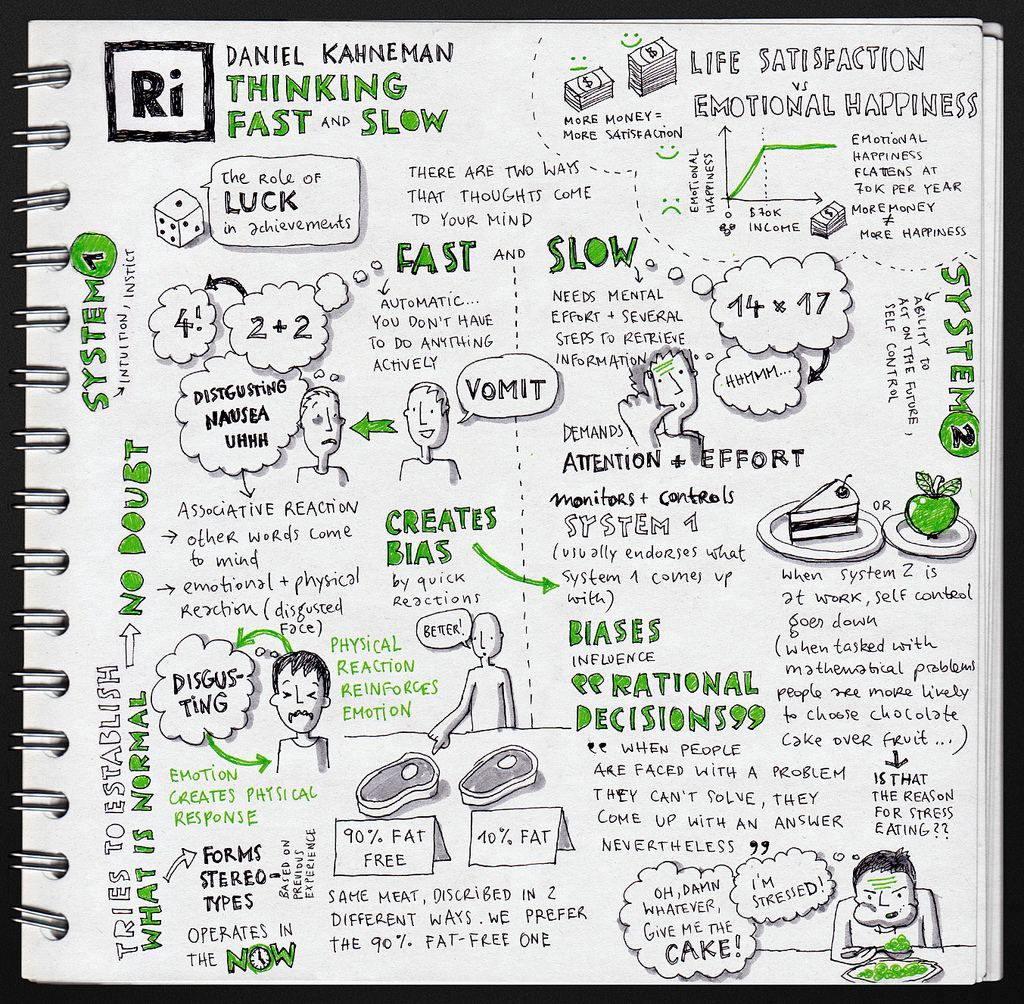
Thinking fast grow summary

Avoiding Sep 11 Attacks, Happy Marriage Equation & Better Thinking Ideas

Thinking_Fast_Slow_Summary

First Things First – Daniel Kahneman’s “Thinking, Fast And Slow” Is A Must Must Read Book ! Yes – READ IT. It Is One Of The Best Investments You Will Make.

Daniel Kahneman is the first non-economist to profession to win the Nobel Prize in Economics. But do not worry – the book is easy read and very though-provoking. The book aims to help us understand our systematic errors (biases) so that we an anticipate, identify and avoid them. An accurate diagnosis of our errors of judgement and choice may prevent or limit the damages of our errors.

The central theme is that our minds have two systems for making decisions – System 1 and System 2.

System 1 operates automatically and quickly, with little or no effort and no sense of voluntary control.
System 2 allocates attention to the effortful mental activities that demand it, including complex computations. The operations of System 2 are often associated with the subjective experience of agency, choice, and concentration.

The books speaks of the role and importance of System 1 in our lives and decisions – intuitions, illusions. It controls us more than we think it does. We become strangers to ourselves. Eventually, System 2 should drive us. And if System 1 is driving us, we should slow down and change course.

The book touches upon many topics and each one is worth diving further into. I am resisting my temptation to write about all of them – as I want you to read the book.

Let me touch upon selective interesting points:

1. One of the important point is about Focus. Multi-tasking is not a great thing as self-control and deliberate thought apparently draw on the same limited budget of effort. Self-control requires attention and effort. Focus and maintaining a consistent thought process requires discipline. Hence tired and hungry judges tend to fall back on the easier default position of denying requests for parole rather thank think more deeper on merits of the case.

2. High correlation exists between thinking and self-control. People with high self-control have higher measures of executive control in cognitive tasks, and especially the ability to reallocate their attention effectively. The children who had shown more self-control as four-year-olds had substantially higher scores on tests of intelligence. There is a significant difference in intellectual aptitude between people with different self-control.

3. Another interesting finding is the idea of money primes individualism: a reluctance to be involved with others, to depend on others, or to accept demands from others.

4. Cognitive Ease allows System 1 to be in control while Cognitive Strain determines whether System 1 should involve System 2. Hence marketing works on creative cognitive ease and lead us to intended behaviours. Using bold colors, simpler language helps. If the message is to be printed, use high-quality paper to maximize the contrast between characters and their background. If you use color, you are more likely to be believed if your text is printed in bright blue or red than in middling shades of green, yellow, or pale blue. As we all know, repetition induces cognitive ease and a comforting feeling of familiarity. It is the exposure effect. A good mood weakens System 2 and hence one needs to be extra careful. Similarly, one should not dismiss an idea because it is badly packaged in a hard language or bad font.

5. The Wisdom of Crowds indeed makes sense. A collective judgement is often superior to individual judgements.

6. Whenever taking decisions, ensure that the different biases are checked:
Halo Effect
Substitute Effect
Anchoring
Availability
Optimism Bias

A checklist is a great tool for making decisions.

Example of Availability Bias: People feel politicians and celebrities often resort to Adultery? Does the aphrodisiac of power cause such behaviour? Statistically, politicians and celebrities have same amount of affairs as other people – it is only that their cases get highlighted more in the media and we tend to feel that they are more morally challenged.

7. Bad News: Some experimenters have reported that an angry face “pops out” of a crowd of happy faces, but a single happy face does not stand out in an angry crowd. The brains of humans and other animals contain a mechanism that is designed to give priority to bad news. By shaving a few hundredths of a second from the time needed to detect a predator, this circuit improves the animal’s odds of living long enough to reproduce. The automatic operations of System 1 reflect this evolutionary history. No comparably rapid mechanism for recognizing good news has been detected. Of course, we and our animal cousins are quickly alerted to signs of opportunities to mate or to feed, and advertisers design billboards accordingly. Still, threats are privileged above opportunities, as they should be.

8. The sunk-cost fallacy keeps people for too long in poor jobs, unhappy marriages, and unpromising research projects.

9. people expect to have stronger emotional reactions (including regret) to an outcome that is produced by action than to the same outcome when it is produced by inaction

10. The greatest test for professionals including fund managers is persistent achievement.

Most of the buyers and sellers know that they have the same information; they exchange the stocks primarily because they have different opinions. The buyers think the price is too low and likely to rise, while the sellers think the price is high and likely to drop. The puzzle is why buyers and sellers alike think that the current price is wrong. What makes them believe they know more about what the price should be than the market does? For most of them, that belief is an illusion.

The book contains many memorable quotes. For example:
– Pupil of the eye is the window to the soul.
– Emotional tail wags the rational dog

The book is replete with rich examples and interesting anecdotes. Some examples were really amazing and though-provoking.

1. The Equation for Success

According to Kaheman, his favourite equation is:

Success = Talent + Luck
Great Success = A Little More Talent + A Lot Of Luck

We tend to undermine the role of luck. Whether analyzing stock markets or other events, we tend to ignore the role of luck.

2. The Formula for Marital Stability

Frequency of Lovemaking minus frequency of quarrels

Sounds obvious? Now this is endorsement from the Nobel-prize winning Guru!

3. The September 11 Attacks

If an event had actually occurred, people exaggerated the probability that they had assigned to it earlier. If the possible event had not come to pass, the participants erroneously recalled that they had always considered it unlikely.

The worse the consequence, the greater the hindsight bias. In the case of a catastrophe, such as 9/11, we are especially ready to believe that the officials who failed to anticipate it were negligent or blind. On July 10, 2001, the Central Intelligence Agency obtained information that al-Qaeda might be planning a major attack against the United States. George Tenet, director of the CIA, brought the information not to President George W. Bush but to National Security Adviser Condoleezza Rice. When the facts later emerged, Ben Bradlee, the legendary executive editor of The Washington Post, declared, “It seems to me elementary that if you’ve got the story that’s going to dominate history you might as well go right to the president.” But on July 10, no one knew—or could have known—that this tidbit of intelligence would turn out to dominate history.

Could better thinking have changed the course of history?

4. Michael Lewis’s bestselling Moneyball is a story about the inefficiency of the traditional mode of prediction. Professional baseball scouts traditionally forecast the success of possible players in part by their build and look. The hero of Lewis’s book is Billy Beane, the manager of the Oakland A’s, who made the unpopular decision to overrule his scouts and to select players by the statistics of past performance. The players the A’s picked were inexpensive, because other teams had rejected them for not looking the part. The team soon achieved excellent results at low cost.

5. The basic message of Built to Last and other similar books is that good managerial practices can be identified and that good practices will be rewarded by good results. Both messages are overstated. Because luck plays a large role, the quality of leadership and management practices cannot be inferred reliably from observations of success. And even if you had perfect foreknowledge that a CEO has brilliant vision and extraordinary competence, you still would be unable to predict how the company will perform with much better accuracy than the flip of a coin. On average, the gap in corporate profitability and stock returns between the outstanding firms and the less successful firms studied in Built to Last shrank to almost nothing in the period following the study. The average profitability of the companies identified in the famous In Search of Excellence dropped sharply as well within a short time. A study of Fortune’s “Most Admired Companies” finds that over a twenty-year period, the firms with the worst ratings went on to earn much higher stock returns than the most admired firms.

Photo Credit:

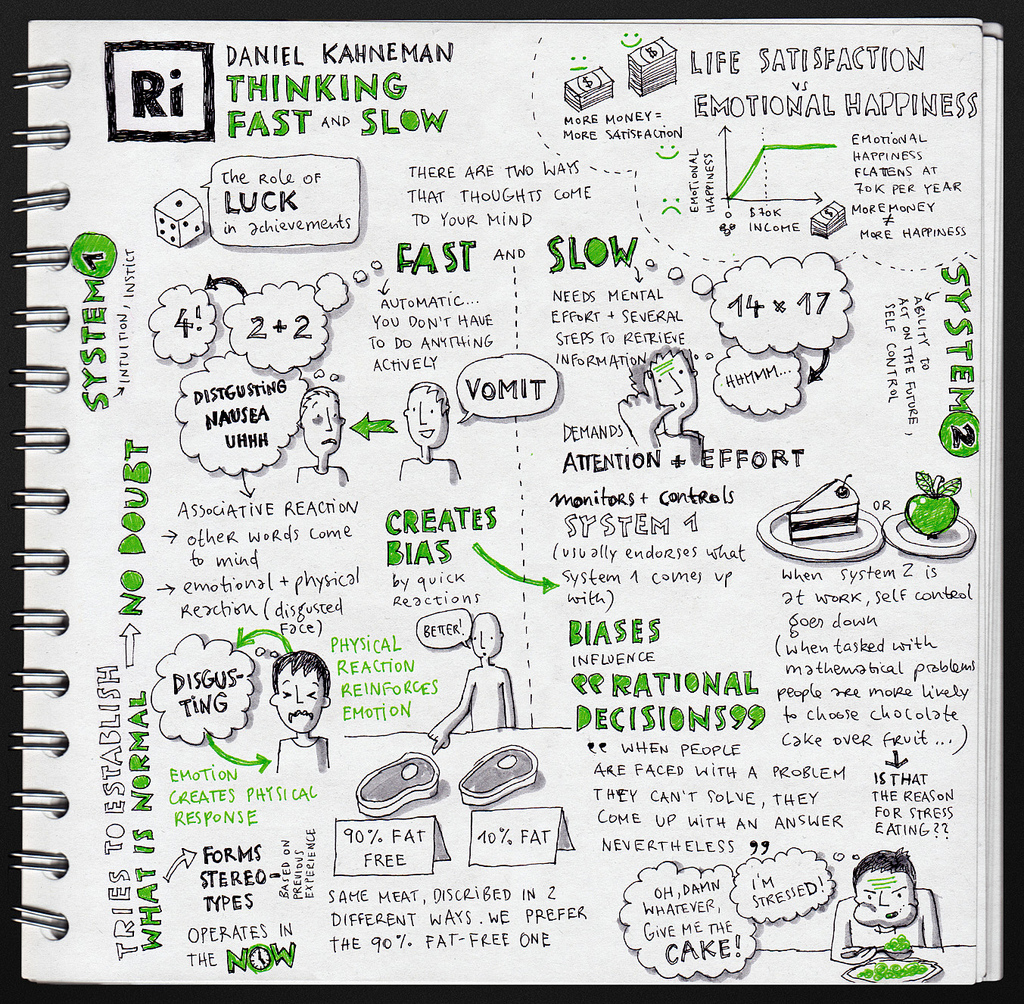
Please Find A Very Interesting Snapshot Of The Book by: Eva-Lotta Lamm

This sketchnote is featured in Eva-Lotta’s new book that gathers her sketchnotes from over 100 talks taken at design events and conferences in 2011.
 
In addition, Eva-Lotta invited 10 of her favourite sketchnoters from all over the world to contribute to the book. They all sketched the same TED talk and created some stunning sketches that show off the wide variety of styles and different ways of summarising content.
 
www.sketchnotesbook.com

1 51 52 53 54 55 56 57 194