The Atmantan Method: Therapies & Activities
Atmantan does not offer a menu of generic spa services with vaguely Sanskrit names. Its practitioners — many from Kerala, others from the Northeast, Maharashtra, Bengal, Odisha — carry knowledge and technique that can be immediately distinguished from the decorative massages of a five-star hotel. You feel the difference within minutes.
We experienced the following therapies and activities:
1. The Morning Yogic Kriyas
Each day opened with Yogic Kriyas — a systematic cleansing sequence rooted in Hatha Yoga. Neti: warm saline water flowing in through one nostril and clearing through the other, purifying the sinus passages. Gargling: deep-throat cleansing that most of us have never done properly. Eye exercises: thirty rapid blinks, followed by six deliberate rotations in each direction — left, right, up, down, clockwise, counter-clockwise — reactivating the ocular muscles grown lazy under fluorescent light and screen glare.
It sounds clinical in description. In practice, especially at six in the morning with mist on the valley below, it felt like an act of genuine self-regard — the deliberate care of a body one has perhaps been taking for granted.
2. Laghu Shankha Prakshalana — The Great Internal Rinse
LSP is one of the more extraordinary experiences available to the guest willing to surrender ego for approximately ninety minutes. The name comes from Sanskrit: shankha — the conch shell, referring to the entire alimentary canal from mouth to anus — and prakshalana — to wash completely. It is exactly that.
The practice: warm saline water consumed in measured rounds of two glasses, interspersed with five specific yoga asanas that mechanically move the water through the digestive tract. Round after round, the process continues. The body begins to release — solid waste first, then progressively clearer, until what emerges is essentially the clean water you drank, signalling a genuinely emptied and flushed gastrointestinal system. One returns to the room afterwards and eats, as prescribed, a plain moong dal khichdi with a touch of ghee — a meal that lands like a blessing in a body that has just, perhaps for the first time in years, been completely clean inside.
LSP can be practised once every one to three months. We intend to make it an annual ritual — and are quietly planning to introduce our children to it under proper guidance.
3. Massages — The Art That Will Not Be Taken Away By AI
Atmantan’s therapists operate on a different register from any spa massage I have experienced. These are practitioners who use not just their hands but their forearms, elbows, and body weight — redistributing energy rather than simply applying pressure. Each therapy comes with a verbal brief: what it does, why it has been prescribed for you, what to expect.
The Green Tea Scrub lifts dead skin and awakens circulation, leaving the skin with an improbable smoothness.
Manual Lymphatic Drainage — through light, rhythmic strokes following the lymphatic pathways — restores flow to a system congested by travel, desk work, and stress.
The Signature Atmantan Massage uses warm basalt stones alongside oils specific to the season; the stones allow the therapist to work at a depth impossible with hands alone.
Udwarthanam — a two-therapist Ayurvedic treatment of simultaneous upward massage with warm herbal paste — is both exfoliating and deeply stimulating.
The Chi Nei Tsang (Abdominal Massage) devotes fifty focused minutes to the gut: confronting and liberating in equal measure, releasing not just physical tightness but, for many guests, something more layered and harder to name.
4. Fitness – Moving The Body — Multiple Ways To Sweat
Daily group activities include Pilates, Aqua Aerobics, Yoga, Zumba, Bollywood Dance, Pranayama, and Laughter Therapy — a session which initially produces self-conscious, performative laughter and then, surprisingly, genuine laughter, which seems to be the point.
Bollywood Dance deserves a special mention. Forty-five minutes disappeared in what felt like five. Somewhere between awesome choreography, enthusiastic participation, and a soundtrack that refused to let anyone remain serious, fitness quietly disguised itself as joy. It was one of the few workouts I wished had lasted longer.
The highlight was Neuro Reactive Training — a methodology built on dynamic, unpredictable stimulus-response sequences that challenge the brain and the body simultaneously. Eight stations, one minute each: strength, reflexes, balance, coordination, explosiveness — all demanded in rapid succession. After years of repetitive gym routines, this was the most genuinely stimulating physical experience I can recall. The adrenaline was real. I was grinning uncontrollably by station five.
5. The Daily Meditation – Sitting With The Soul
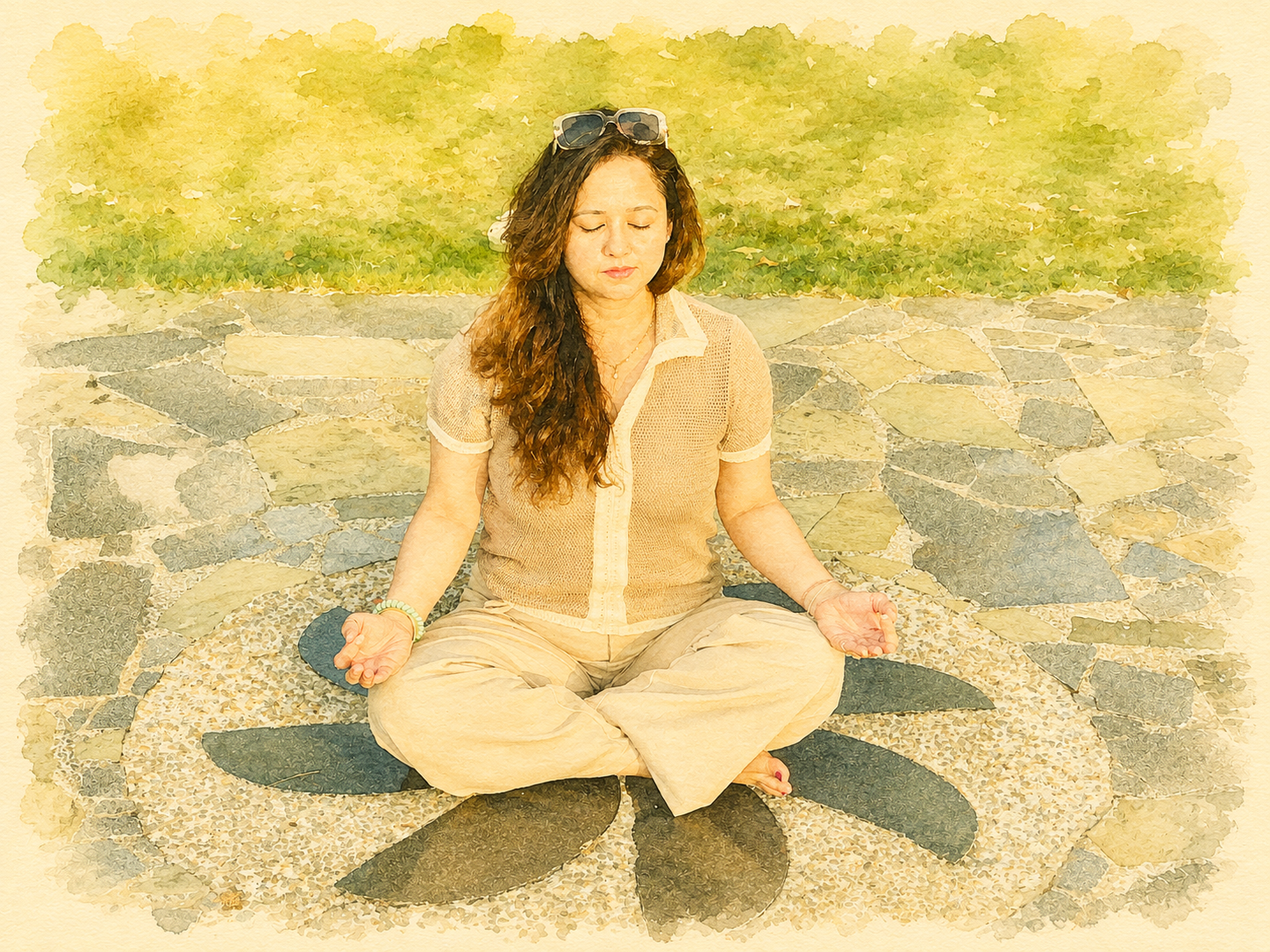
Every evening, after the body had been stretched, pressed, challenged and nourished, the soul was invited into the conversation.
We experienced meditation sessions that spanned multiple modalities: Twin Heart Meditation (moving attention through the heart centre and crown before radiating compassion outward), Chakra Meditation, Trataka (candle-gazing, one of the classical concentration practices of Hatha Yoga), and Omkar — the resonant, sustained intoning of Om that one dismisses as cliché until one actually does it properly and feels the vibration move through the chest cavity and into the skull.
Some were familiar. Some were new. All of them created pauses.
I realized something simple: I have spent much of my life sharpening the mind. In recent years, like many of us, I have also become more conscious of the body. But the soul — that quiet, luminous, inner dimension — often gets leftover attention. No popular metric tracks it. No biometric captures its state. And yet its neglect is quietly felt everywhere.
Atmantan gently restores the triangle.
Body. Mind. Soul.
Not as a slogan. As a lived sequence.
6. The Sahyadri Trek — Where The Mountain Becomes The Medicine
On Sunday morning, after kriyas, twenty-some guests from Chile, Malaysia, Dubai, the United States, Europe, and several postcodes of Ahmedabad assembled for a trek into the Sahyadri range. The hill was steep; the reward, comprehensive.
At the summit, a small Ganesh temple. We stopped. The sky delivered a brief, perfect rain — just a few minutes of cool drizzle, as though on schedule. We ate slices of apple and pear and shared, in the way people do when they have just climbed something together, more of our lives than we would have at sea level. The descent was quicker. Conversations went deeper. The group — engineers, students, government officials, entrepreneurs, Ivy League graduates — had, for this hour, the same muddy shoes and the same enormous view.
7. Grounding — The Oldest Medicine
There is, in the Atmantan grounds, a dedicated barefoot walking path. Guests are gently invited — not instructed — to use it in the early morning.
The practice is called Earthing, or Grounding. When bare skin contacts the Earth’s surface — grass, soil, wet stone — a transfer of electrons occurs. The Earth carries a net negative charge; the human body, perpetually exposed to electromagnetic radiation from devices and artificial lighting, tends to accumulate a net positive charge. Direct skin contact with the Earth neutralises this imbalance, restoring the body’s electrical baseline to something close to its evolutionary norm.
The benefits documented in the peer-reviewed literature include reduction in systemic inflammation, improved blood viscosity, better glucose regulation, enhanced sleep, and reduced cortisol. These are not trivial effects from a trivial cause.
Our Indian customs always said: remove your shoes at the temple, at the school, entering the home. We dismissed this as ritual. It turns out it was also physiology. The ancients, working by inference and observation across millennia, had arrived at the correct answer.
I walked barefoot on the grass every morning. By day seven, I was doing it before breakfast without thinking about it. That, I have come to believe, is how the best of what Atmantan teaches actually travels home — not as a resolved intention, but as a new habit so quietly embedded it has already stopped feeling like effort.
Digital Detox: Watching Nature Instead of Reels
One of the most powerful therapies at Atmantan is not listed as a therapy.
Disconnection.
There was limited connectivity in common areas. Wi-Fi was mostly functional in the rooms. This changed the energy of the stay. Restaurants became places of conversation. Walkways became spaces of observation. Mornings became softer. Nights became quieter.
Instead of watching AI-manufactured reels, we watched the play of nature.
Instead of scrolling through other people’s lives, we listened to our own.
I rediscovered the joy of reading a book while the breeze and sunshine sat beside me like old friends. I remembered that boredom is not an enemy. It is often the doorway through which reflection enters.
NEXT: Part 3 — The Food & The Atmantan Tribe