Kshamapan – Michammi Dukkadam – The Festival Of Forgiveness

Forgiveness is the supreme act of courage!

It is an act of faith and humility. It releases both the parties to move on and build a new tomorrow.However, it is very difficult to execute. Equally difficult is forgiving oneself!

However, we need to start somewhere!

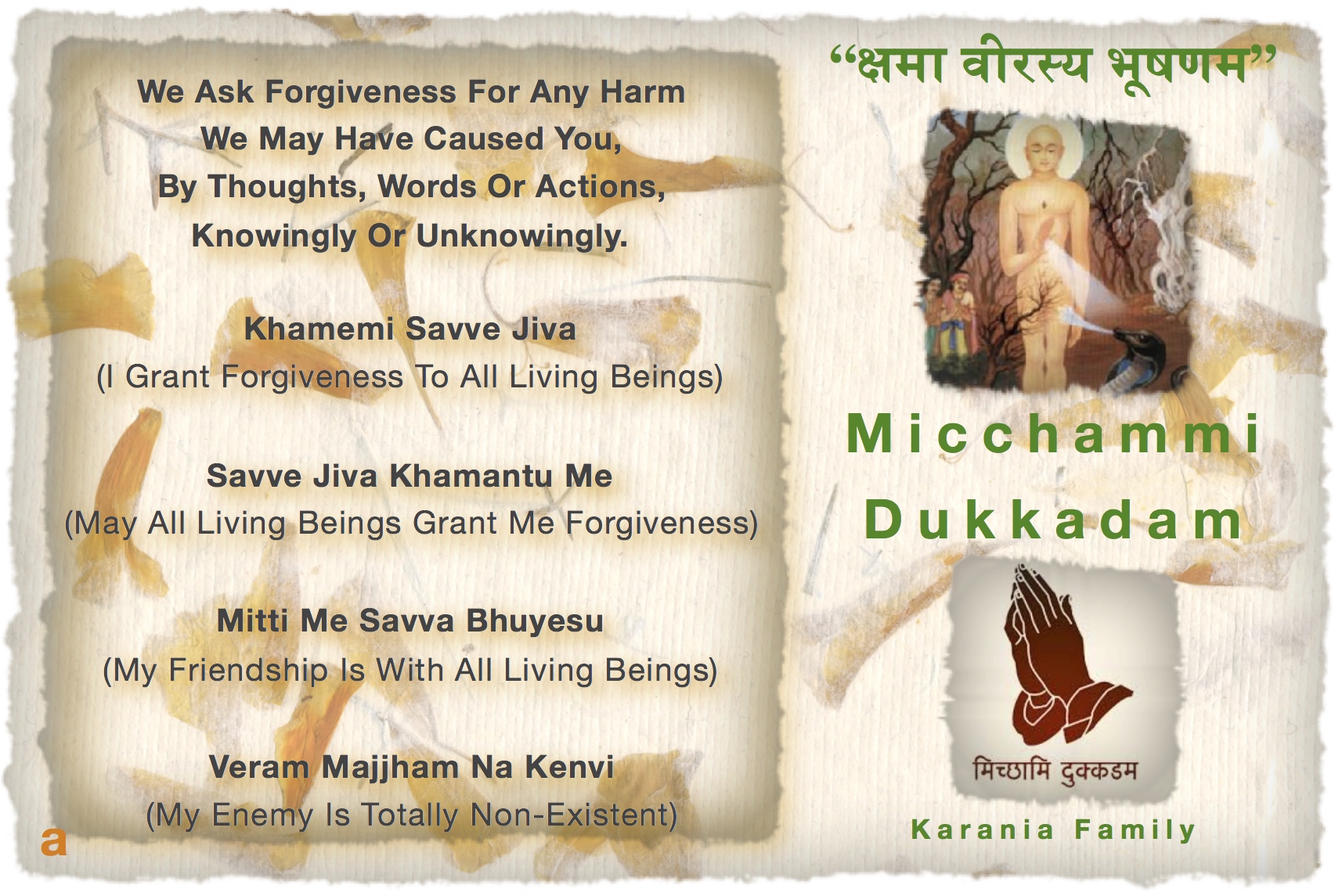
And nothing better than the holy day of Samvastari – the last day of Paryushan – the biggest Jain Festival. On this day, all Jains ask for forgiveness by saying – Michammi Dukkadam.

Dear Friend

I ask for forgiveness, if I may have hurt you, intentionally or unintentionally, by Thoughts, Words or Action.

Micchami Dukkadam !

Oxford – Gujaratilexicon Collaborate For Digital Experience In Local Language

Gujaratilexicon is pleased to announce the launch of the Gujarati Living Dictionary as part of the Oxford Global Languages (OGL) initiative.

The OGL programme is building dictionaries and lexical resources for around 100 of the world’s languages and making them available online. The Gujarati Living Dictionary is launched as a part of a special focus on Indian languages.

Explore the Gujarati Living Dictionary at: https://gu.oxforddictionaries.com/

Judy Pearsall, Director for Oxford Dictionaries put forward the motivating philosophy in her own words: “Digital communication across the globe is dominated by English and other major global languages. We are at a critical time in the nexus of the internet and its impact on language diversity and viability, and the time to act is now. OGL is a mission to help digital communication through building resources for the world’s languages. India has a remarkable linguistic landscape with a richness and history that is found in few other places on the planet. But only 35 percent of the Indian population use the internet. Hence we are putting a special focus on Indian languages and aim to work for more initiatives in this space.”

Gujaratlexicon is the thought leader in Gujarati language space and aims to preserve, popularize and develop Gujarati language through the power of information technology.

Dr. Ashok Karania, Mentor of Gujaratilexicon is enthused about the collaboration between Oxford and Gujaratilexicon. He says: “We are humbled to be a part of the global initiative of Oxford to transform digital experience for the non-English world by providing content and tools in local languages. Gujarati is the language of the enterprising people across the world and this initiative will inspire further technology, research and education programs for diasporic and local Indians. As digital era and AI transform the technology world, the personal human experience will be more important than ever and technologies in local language will ensure those expressions”

About OGL:

Oxford Global Languages (OGL) is a major initiative from Oxford Dictionaries, part of Oxford Univeristy Press, which launched in 2014. OGL aims to transform the experience of millions of people worldwide by making their language available in digital form – on websites, in apps, and via other tools.

OGL records how living languages, including their variants and dialects, are used today. The result is a vast data store of language data that is accessible, linked, and reusable. https://www.oxforddictionaries.com/ogl/

About GL:

Gujaratilexicon is a landmark work in the history of Gujarati language containing resources of more than 45 lakh words. It aims to contemporize Gujarati language and develop rich and relevant Gujarati language resources.

The mission is the result of undying passion and relentless vision of Amar Shri Ratilal P. Chandaria, who spent more than 25 years on this project. The leading Gujaratilexicon projects include Digital Bhagwadgomandal, Digital Sarth Kosh, LokKosh, Lets Learn

Gujarati, Crossword, Gujaratilexicon Mobile Application, Global Gujaratilexicon, Gujarati Games, eBooks etc. It is supported by Chandaria Foundation & Arnion Technologies. https://www.gujaratilexicon.com

The Golden Age of Technology

The Golden Age of Technology

Elon Musk is a genius. Recently, he asked American Governors to regulate Artificial Intelligence (AI) before it’s too late. Musk’s position on AI is known but his recent comments again brought the debate of intrusion of technology in our lives? Is the golden age of technology over? No. Musk’s concerns withstanding, we are embarking on a golden age of technology globally.

Technology excites us. Technology frightens us. Technology amazes us. Technology arouses us. Technology challenges us. Technology is all around us. Technology is a part of our daily lives. The continuous improvement and rise of technology has created new possibilities.

We are embarking on a golden age of technology thanks to the combined forces of Smart Devices, Global Connectivity, Cloud Power, Machine Learning & Data Analytics. I called it the DNA of new age of technology – Devices & Data, Networks & Connectivity, Analytics. The DNA is connecting different technology dots and creating disruptive ideas. The disruptive ideas are scaling fast to change business models and influence our digital lives. The impact of technology is real when politicians smart promising faster internet, digital government and smart IOT cities to win votes!

1. Devices & Data

Devices are smarter, faster, cheaper and loaded with sensors. The devices include micro-buttons and chips. Human body and car can be a device itself. The skin stickers can capture vital body stats. Ingestible sensors can give the real view of what is happening inside your body. Beacons in airports, retails stores, hospitals, warehouses, museums are a reality now.

Data is the new oil. Huge amount of data is being captured on an ongoing basis. Mobile phones, apps, browsers, sensors, fitness devices etc. are some of the avenues through which data is regularly captured. We have collected more data in last two years than in last 20 years.

2. Networks & Connectivity

The proliferation of connectivity across the world is a big booster to the technology aspirations of mankind. As countries get faster and reliable internet connectivity, it will open traditional vestiges to innovation. The connectivity will boost existing and new businesses and empower citizens. As countries realize that their GDP and connectivity are positively co-related, the investments in connectivity will continue. And it will boost new technologies like drones, robots and autonomous cars.

The widespread availability of internet and internet access has opened the quick collection, transmission and analysis of data. We also have the capability to store huge amount of data in large data warehouses or leverage cloud options like AWS, Azure etc.

3. Analytics & Predictive Intelligence

The huge collection of data opens the possibility for rich analysis. The huge processing power is available at cheap rates and new software frameworks help to analyse the huge amount of data being collected. Not only are we now capable of analysing the past data, but we can predict the future. We can determine ongoing patterns to make important predictions relevant recommendations. We are all used to Amazon recommendations, but we also have recommendations for clothing, food to eat, restaurants to visit. As the data gets enlarged and enriched, we will get more intelligent recommendations.

The machine learning and analytics are powering connected intelligence. The mundane and hazardous tasks can be taken over by technology leaving the humans to focus on more value-enriching tasks. The technology intelligence and algorithms can make better decisions than human beings. Finance, healthcare, governance, transport, educations are being disrupted.

Is the golden age of technology real?

The paradigm shifts are causing changes in business, economic models, governance and our daily lives. The combined forces of DNA are solving biggest problems of the world. The world is moving towards better health systems, predictive diagnostics, safe driving, removing language barriers, greener technologies, digital governance etc. The possibilities are immense.

Technology giants, governments and innovators must address concerns of privacy, security and economic costs. The systems should be properly tested and compliances must be adhered to. Digital lives need digital assurance. But technology is an irreversible ride. A gun in the hand of a soldier protects the citizens and a gun in the hand of a terrorist harms the citizens. Technology is powered by human minds and it also powers the human mind. We must make the choices. No human being should work in dangerous mines or do scavenging jobs. At the same time, no machine can create magic of Picasso, J K Rowling or Roger Federer!

Image: MIT Technology Review
Agile-Shift-Left-Is-The-Right-Shift!

Agile – Shift Left Is The Right Shift!

AAEAAQAAAAAAAAsmAAAAJGU4MDI1MzU5LWIwNTQtNGViYS04YjE2LTk0Y2U4MmIyNjA0MQ

Summary of Test Focus Roundtable Discussion on Agile Approaches @ London

Digital is the new reality of life. Digital transformation has necessitated the rise of new methodologies and practices to deliver faster, better and scalable products. Agile Methodology is at the epicenter of the new technology philosophies and tactics.

Recently, Qmetry Team with Test Magazine hosted a roundtable discussion on the Agile & Shift Left approaches at the Test Focus event. Agile is a very hot topic was evident from the sheer number of attendees and the vocal debates at the session. We had three power packed roundtable sessions with expert practitioners, scrum masters, new agile converts and fence sitters. They represented large enterprises, mid-size companies and startups. Experts from testing organizations also joined the deliberations. All of this contributed to very insightful and interesting interactions.

Agile, like love, it is a used, over-used and abused term. To me, agile is essentially a mindset. A mindset of breaking up tasks into smaller pieces of work, quick and frequent feedback and adapting to changes. From this perspective, agile way of doing things is as old as the mountains. In fact, the agile principles have been seen in extreme programming and other practices.

Agile is not just scrums and sprints. These represent only the tools and methods. Apart from the mindset, core agile practices include the adoption of following concepts from a testing perspective:

1. Unit Testing
2. Distributed Teams
3. Refactoring
4. Continuous Integration, Continuous Delivery & DevOps
5. Automated Acceptance Testing
6. Test Driven Development
7. Behavior Driven Development
8. Pair Programming

Organizations should implement the agile methodologies that work of them rather than blindly following the manifesto. They can have Agile, Wagile etc.. At the end of the day, going agile is a decision linked to the organizational need and business case. It is not necessary to adopt all of the above ideas if it does not work for the team.

One interesting point that emerged in the discussion was about automation. The importance of automation is increasing in the agile world. In-sprint automation is a key goal for most of the practitioners and scrum QA teams can work on the same. Some have a separate automation team if their project demands the same. It all boils down to the sprint planning. Many teams are already at Sprint minus 1 automation. Automation of acceptance test is a key success for many organizations.

How to go agile? The fundamental point is to identify the reason to go agile. What is the business case? What is the technology case? Be clear about the expectations and goals. The next stage is to identify agile champions and enthusiastic team members and get a strong cross-functional team of product owners, business users, developers and QA team members. The team with the right attitude is going to make or break the agile projects. It is always important to identify failure or success as a common event rather than finger-pointing at others. The role of the product owner cannot be over-emphasized in setting the right environment and empowerment. The reporting structure of the team needs to be understood and appreciated.

Agile means different things to different people. Hence the most important task is to get the team or organization’s definition of agile right. Let there be a common definition and it should be consistent across the organization. Definition of ‘done’ is so important in determining the success and failure. Developers want to ship products quickly and QA wants to ensure the right assurance – but both should agree on the definition of done.

The final step is to have the selection of right tools. Agile has distributed teams and proper test management tool is required for creating a common view. Agile is about transparency, flexibility, collaboration and joint success. A good test management tool will provide the required transparency and provide a single honest view to all the stakeholders. Rich reports and metrics will help for continuous improvement. One of the important aspects is using the information from the past runs and improve – that is where analytics and actionable intelligence comes into the picture.

So, what did I learn? What do we believe as the key success factors for agile implementation?

1. Clarity of goals
2. Transparency
3. Collaboration
4. Right Tools, Processes & Metrics
5. Flexibility

Image Credit: Lillehammer 2016 Youth Olympic Games

1 43 44 45 46 47 48 49 194